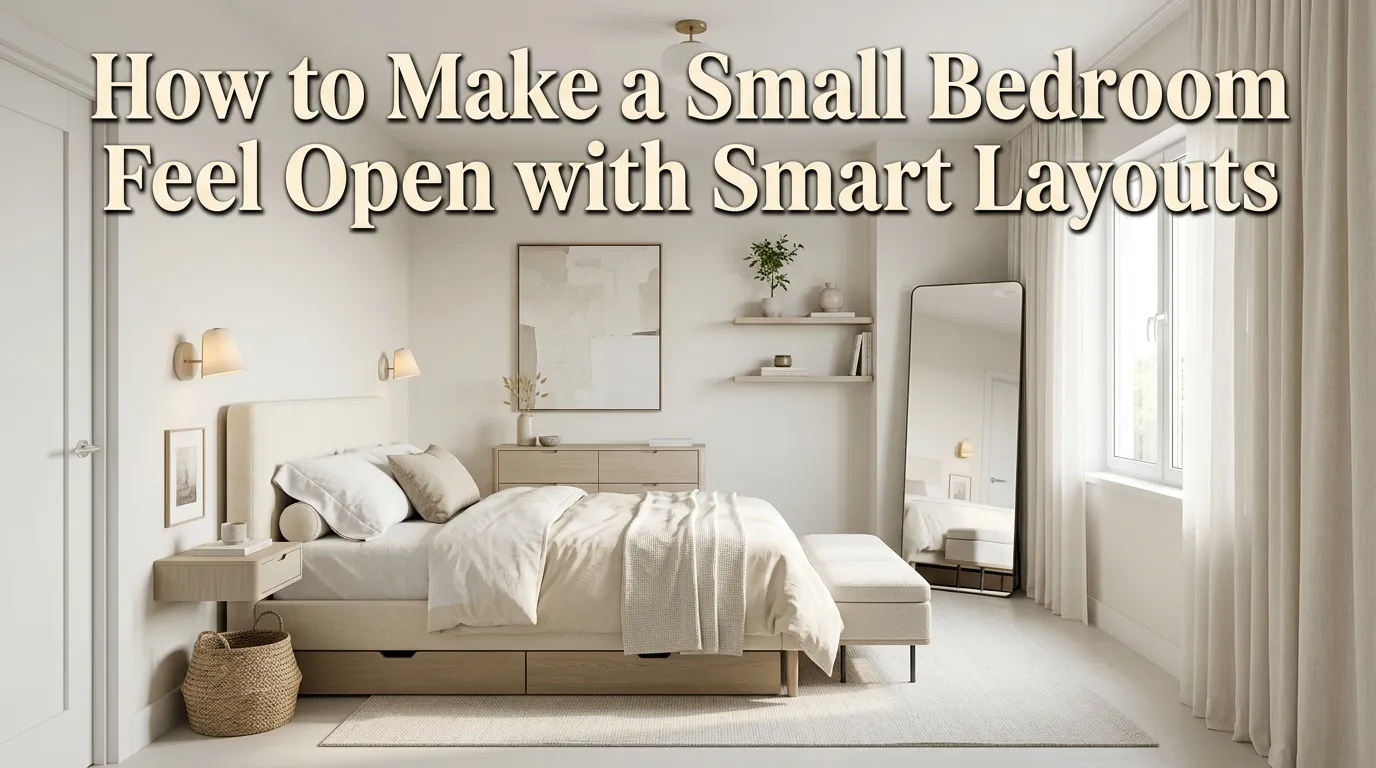
How to Make a Small Bedroom Feel Open with Smart Layouts
A small bedroom doesn’t have to feel cramped, crowded, or difficult to live in.
Sometimes the problem isn’t the number of square feet at all. It’s the way furniture is positioned, the amount of floor space left open, or how easily you can move from one part of the room to another.
A bed that’s slightly too large, a dresser placed in the wrong spot, or a chair sitting in an awkward corner can make a modest bedroom feel much smaller than it actually is.
The good news is that you can often create a more open feeling without knocking down walls, buying expensive furniture, or completely redesigning the room.
The secret is to think about flow before decoration.
In my experience, one of the biggest improvements comes from looking at the room from the doorway first. What do you see when you walk in? Is the main walking path clear? Does furniture interrupt your view? Can you open drawers and closet doors comfortably? These small details have a surprisingly large effect on how spacious a bedroom feels.
You also don’t need to push every piece of furniture against a wall. Sometimes moving the bed slightly, choosing a more efficient orientation, or eliminating one unnecessary piece can make the entire room easier to navigate.
The ideas below focus on practical layouts that work particularly well in compact bedrooms. Whether your room is narrow, square, shared, or simply short on storage, these approaches can help you use the available floor space more effectively while keeping the room comfortable and inviting.
The goal isn’t to make your bedroom look empty.
It’s to make every inch work harder.
Table of Contents
1. Center the Bed
Create a balanced focal point while preserving useful circulation.
2. Clear the Entry
Keep the first view and walking path as open as possible.
3. Use One Wall
Concentrate major furniture along one side of the room.
4. Choose Slim Furniture
Reduce visual and physical bulk with appropriately scaled pieces.
5. Use Corner Space
Turn awkward corners into useful functional zones.
6. Create Vertical Storage
Move storage upward to preserve valuable floor area.
7. Float the Bed
Use alternative bed positioning when the room allows it.
8. Keep Paths Open
Prioritize comfortable movement around furniture.
9. Reduce Furniture
Let go of pieces that don’t serve the room.
10. Use Visual Balance
Make the room feel larger through proportion, light, and repetition.
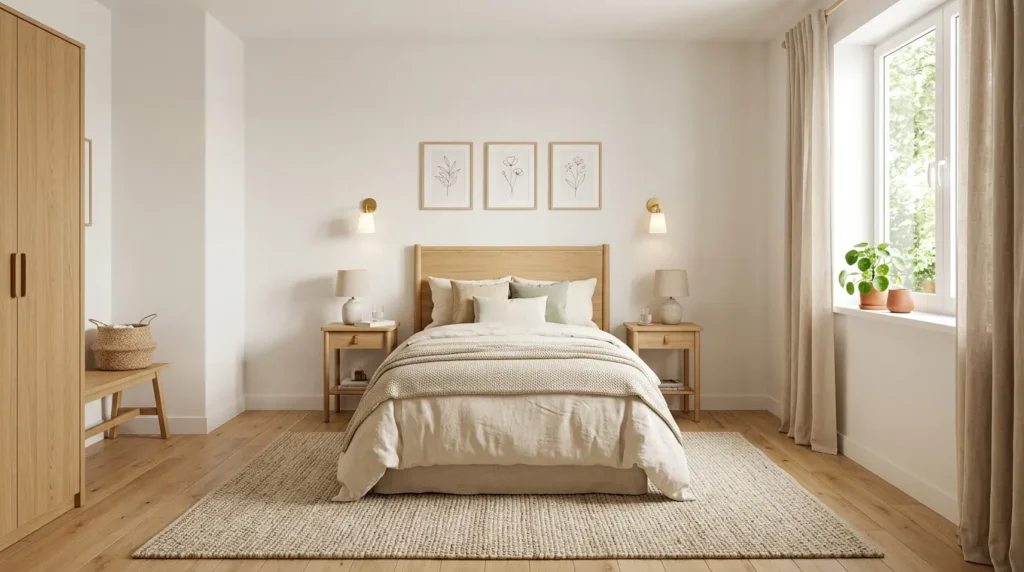
1. Center the Bed
Quick Benefits
- Creates visual balance
- Establishes a clear focal point
- Makes the room feel intentional
- Provides easier access to both sides
- Simplifies furniture placement
Why It Works
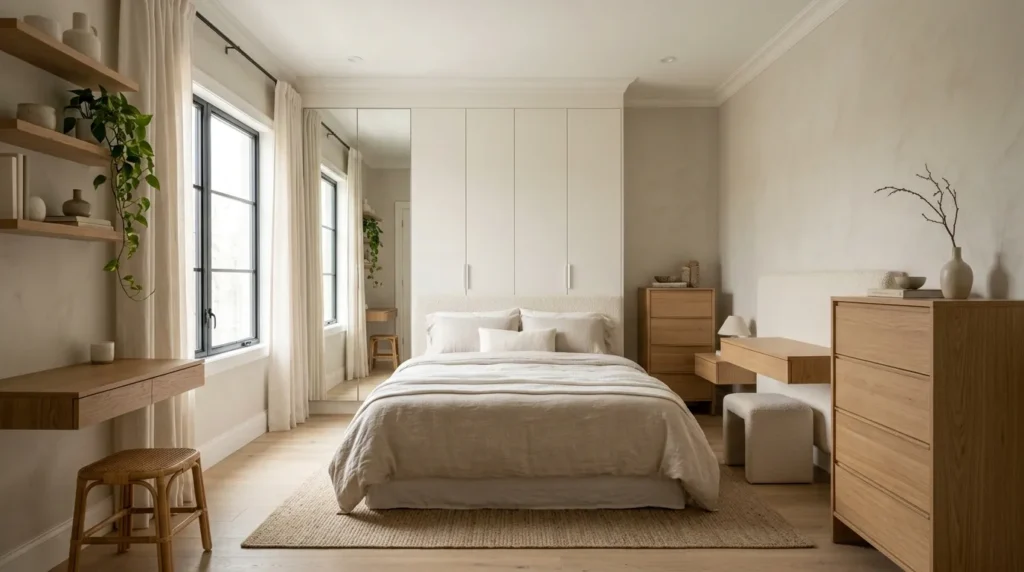
The bed is usually the largest object in a bedroom, so its position has an enormous influence on how the entire room feels.
When possible, centering the bed on the most suitable wall can create a sense of symmetry and order. Even in a small bedroom, this can make the space feel calmer rather than crowded.
The goal isn’t necessarily perfect symmetry. You simply want the bed to have enough surrounding space to feel deliberate instead of squeezed into whatever leftover area is available.
A centered bed can also make decorating easier because it establishes a natural focal point.
How To Style It
Measure the wall and bed before deciding on the final position.
If the room allows it, leave usable space on both sides of the bed for walking and making the bed.
Choose narrow nightstands if traditional bedside tables take up too much room.
Wall-mounted lights can replace bulky lamps on small nightstands.
Keep the bedding relatively simple if the room is already visually busy.
If centering the bed creates a poor walking path or blocks a door, prioritize function instead.
2. Clear the Entry
Quick Benefits
- Makes the room feel larger immediately
- Improves movement
- Creates a stronger first impression
- Reduces visual clutter
- Makes furniture placement easier
Why It Works
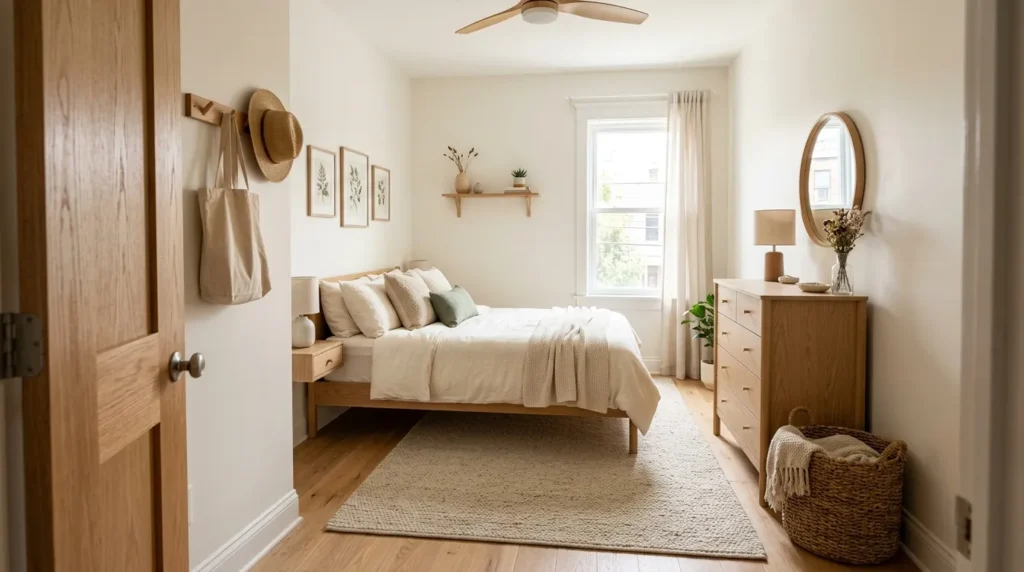
The first few steps into a bedroom can influence how spacious the entire room feels.
If the doorway opens directly toward a pile of furniture, a large dresser, or a crowded chair, the room can feel blocked before you’ve even walked inside.
Keeping the entry area visually and physically clear creates a sense of openness.
You don’t need an enormous empty hallway. Even a relatively modest clear path can make a significant difference.
How To Style It
Stand in the doorway and look carefully at the room.
Identify the furniture that interrupts your view.
If possible, move smaller pieces away from the entry path.
Avoid placing baskets, laundry hampers, shoes, or decorative stools directly where you naturally walk.
If the door swings into the room, make sure furniture doesn’t interfere with its full movement.
Use the first visible wall for a simple focal point rather than a collection of small objects.
3. Use One Wall
Quick Benefits
- Creates a cleaner floor plan
- Makes furniture easier to organize
- Opens the opposite side of the room
- Works well in narrow bedrooms
- Creates a strong visual line
Why It Works
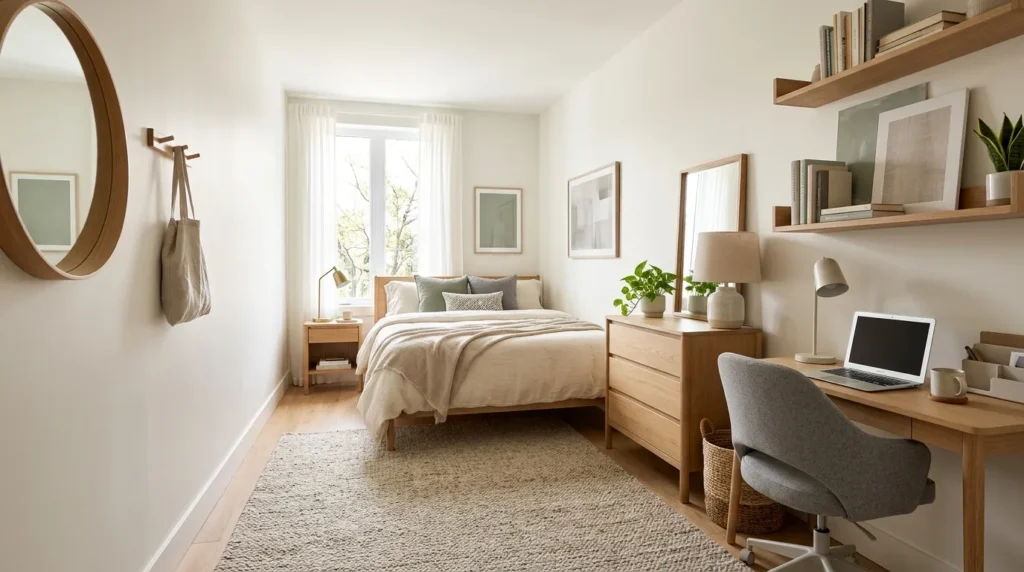
When a bedroom is narrow, distributing furniture across multiple walls can make the room feel even tighter.
Instead, consider grouping several functions along one wall.
For example, a slim dresser, desk, or wardrobe can be arranged in a controlled line, leaving more uninterrupted floor space elsewhere.
This approach can be especially effective in rectangular bedrooms where one long wall provides enough width for multiple pieces.
How To Style It
Start by identifying the longest uninterrupted wall.
Place major storage pieces along that wall when their dimensions allow.
Keep their heights relatively consistent if possible.
Avoid mixing too many bulky pieces.
Leave the opposite side more open for movement.
A large mirror or simple artwork can add interest without taking up floor space.
4. Choose Slim Furniture
Quick Benefits
- Frees floor space
- Improves circulation
- Reduces visual weight
- Works well in narrow rooms
- Creates a lighter appearance
Why It Works
Furniture scale matters enormously in a small bedroom.
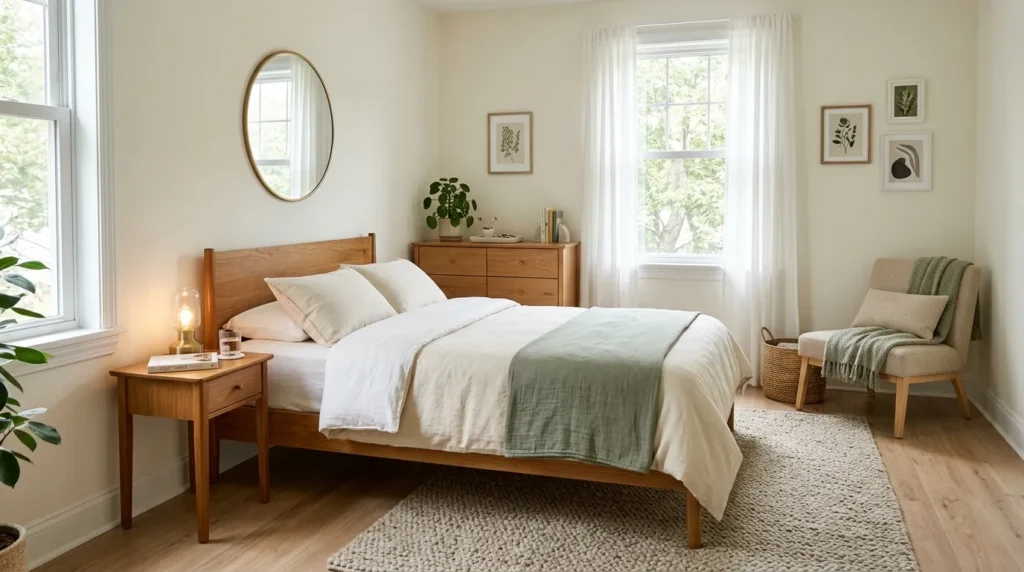
A bulky dresser may provide plenty of storage, but if it takes up too much depth, it can make the walking area feel narrow.
Slim furniture can provide similar functionality while preserving valuable floor space.
This doesn’t mean every piece needs to be tiny. Instead, choose pieces whose proportions match the room.
How To Style It
Measure furniture depth before bringing it into the room.
Look for narrow nightstands, compact dressers, shallow shelving, and furniture with raised legs where appropriate.
Open-leg furniture can also create more visible floor area underneath, which can make the room feel lighter.
Avoid buying furniture simply because it is described as “space saving.” Measure it against your actual room dimensions first.
5. Use Corner Space
Quick Benefits
- Makes awkward areas useful
- Preserves central floor space
- Creates functional zones
- Works well in small rooms
- Prevents unused corners
Why It Works
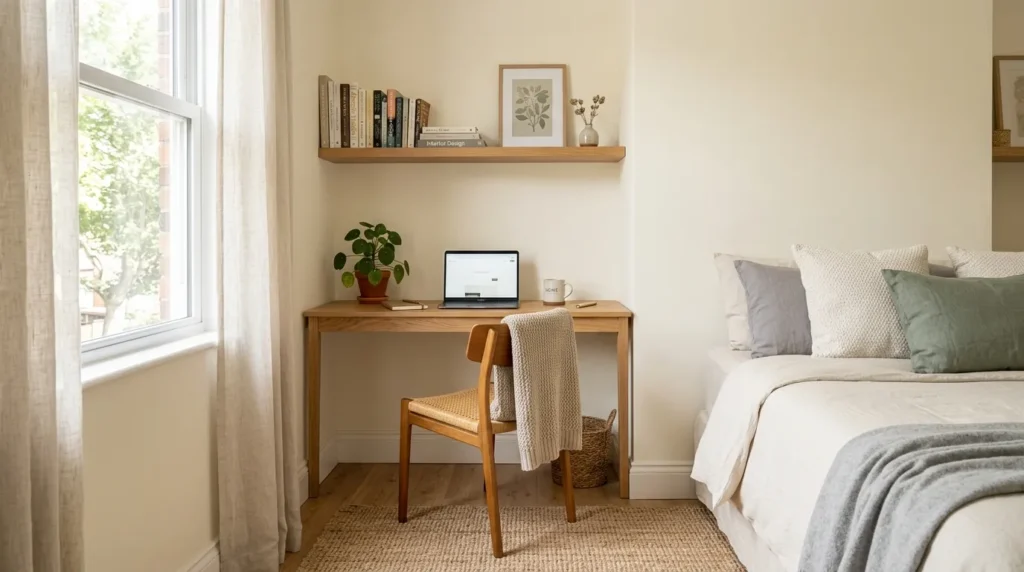
Corners are often treated as leftover spaces, but they can be extremely valuable in a compact bedroom.
A corner can accommodate a narrow desk, small reading chair, hamper, plant, shelves, or compact storage piece depending on the room.
Using corners effectively keeps these functions away from the center of the room, where they can interfere with movement.
How To Style It
Choose the function based on the corner’s dimensions.
A narrow desk can create a compact work area.
A small chair can create a reading spot if there is enough room.
Use vertical shelving when floor space is limited.
Avoid filling every corner simply because it is available.
An empty corner can sometimes contribute more to the feeling of openness than another piece of furniture.
6. Create Vertical Storage
Quick Benefits
- Saves floor space
- Increases storage capacity
- Draws the eye upward
- Reduces clutter
- Works especially well in small rooms
Why It Works
When floor space is limited, look up.
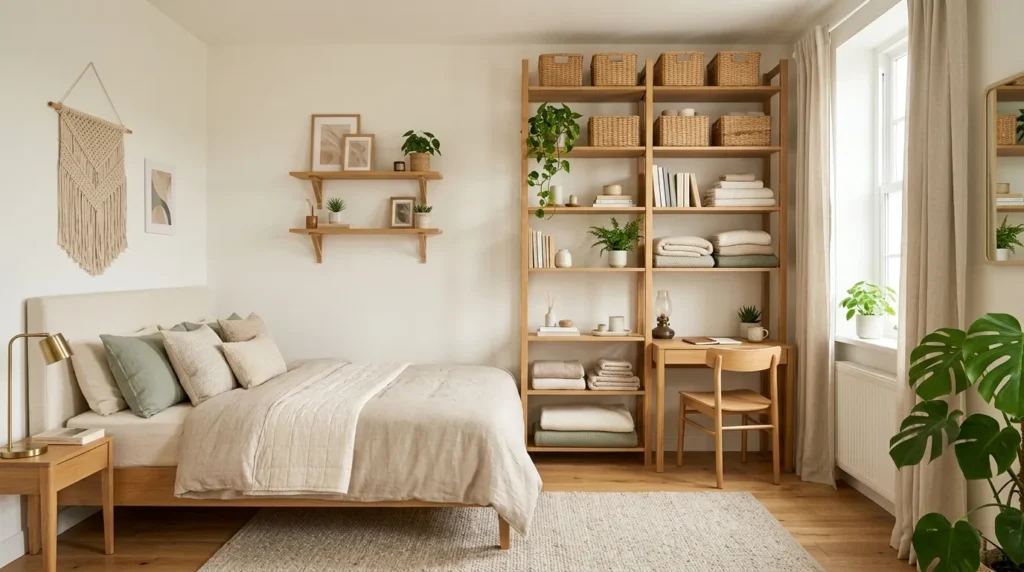
Walls provide valuable storage opportunities that don’t interfere with walking paths.
Tall bookcases, wall shelves, hooks, pegboards, and appropriately installed cabinets can move belongings upward rather than outward.
Vertical storage can also make the ceiling feel taller because it encourages the eye to travel upward.
How To Style It
Use the wall above a desk, dresser, or other suitable area for shelves.
Keep frequently used items within comfortable reach.
Store less frequently used belongings higher up.
Avoid filling every shelf. A little empty space can help the room feel lighter.
If you’re renting, use only hardware and installation methods appropriate for the wall and lease requirements.
7. Float the Bed
Quick Benefits
- Creates alternative circulation
- Can divide functional zones
- Makes unusual layouts work
- Adds flexibility
- Can improve access to storage
Why It Works
Pushing the bed against a wall is common in small bedrooms, but it isn’t always the best solution.
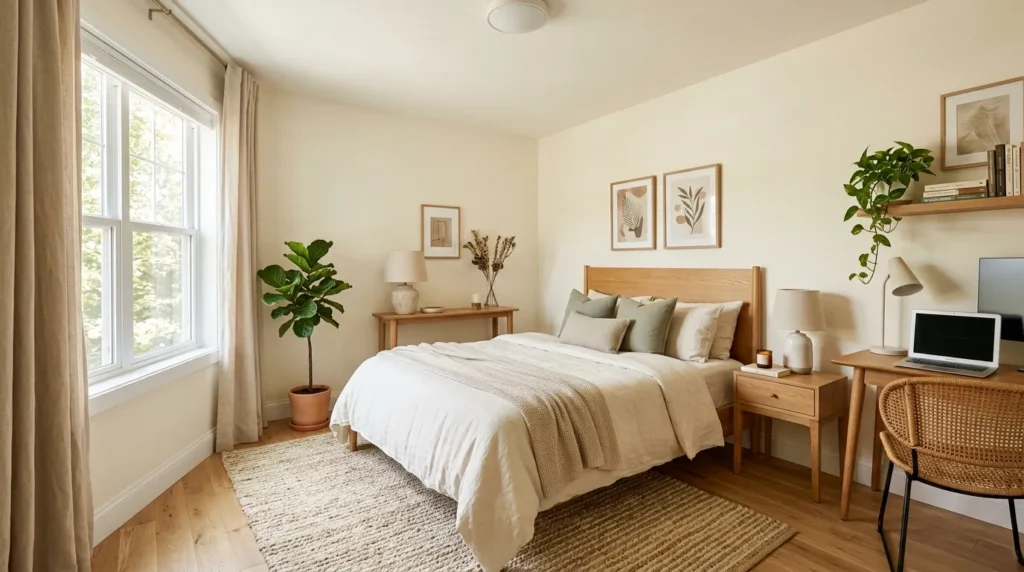
Depending on the room’s shape, slightly floating the bed away from the wall can create better circulation or establish a useful zone behind it.
This approach works particularly well in larger small bedrooms where there is just enough extra floor area to experiment.
In extremely tight rooms, however, floating the bed may take up space you simply can’t spare.
How To Style It
Measure carefully before moving the bed away from the wall.
Check that you still have comfortable walking space.
Use the area behind the bed for a narrow console, low storage, or simply leave it open.
Avoid creating a narrow gap that becomes difficult to clean.
If the room is wide enough, a floating bed can visually separate the sleeping area from a small desk or dressing zone.
8. Keep Paths Open
Quick Benefits
- Improves everyday comfort
- Makes the room easier to clean
- Creates visual openness
- Prevents furniture from feeling crowded
- Helps define functional zones
Why It Works
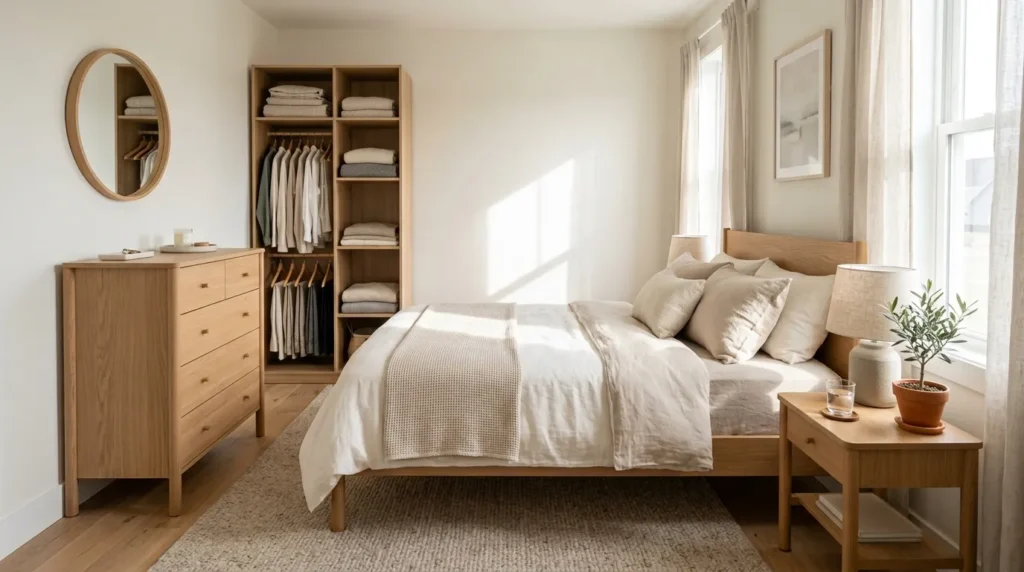
A room can contain relatively little furniture and still feel cramped if the walking paths are awkward.
Think about your daily movements.
You get out of bed, walk to the closet, open drawers, reach the window, and move toward the bathroom or doorway.
Furniture should support these movements rather than constantly forcing you to squeeze around corners.
How To Style It
Walk through your normal morning routine after arranging the furniture.
Open closet and dresser drawers fully.
Check whether doors can swing freely.
Make sure the path around the bed isn’t blocked by baskets or chairs.
Keep frequently used routes as clear as possible.
If something repeatedly gets moved out of the way, that’s useful information. The layout probably needs adjustment.
9. Reduce Furniture
Quick Benefits
- Creates more floor space
- Reduces visual clutter
- Makes cleaning easier
- Improves circulation
- Helps important pieces stand out
Why It Works
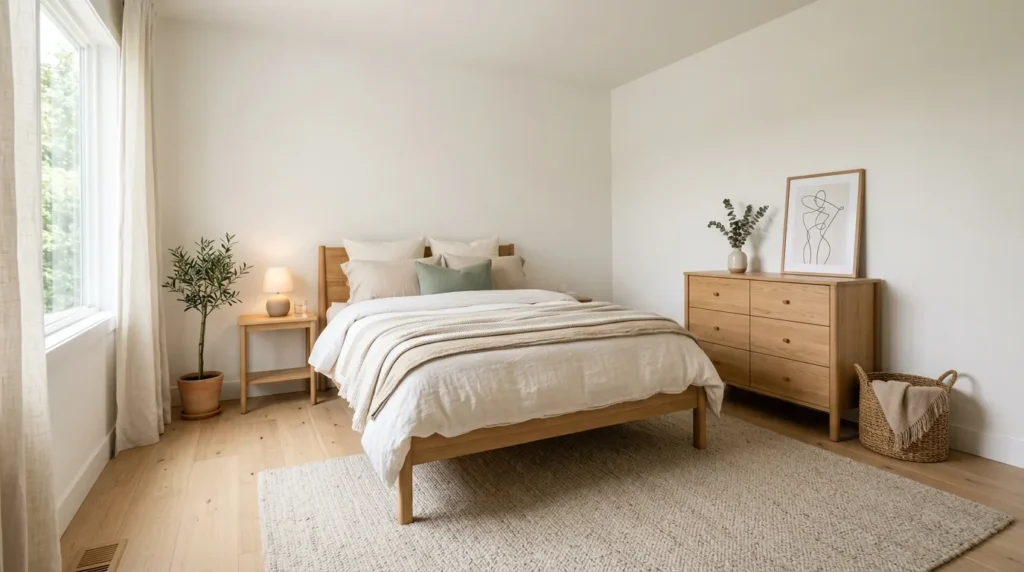
Sometimes the best small-bedroom layout starts by removing something.
A chair that rarely gets used, an oversized nightstand, an extra dresser, or a decorative cabinet can occupy valuable space without providing enough benefit.
It’s easy to think every empty corner needs furniture, but open space is part of the design.
A smaller number of useful pieces can make the room feel considerably more spacious.
How To Style It
Walk around your bedroom and evaluate every major furniture item.
Ask:
- Do I use this regularly?
- Does it provide necessary storage?
- Does it improve the room’s function?
- Could another piece serve the same purpose?
Remove one unnecessary item temporarily and see how the room feels.
You may discover that the empty space is more valuable than the furniture.
10. Use Visual Balance
Quick Benefits
- Makes the room feel calmer
- Creates a sense of proportion
- Reduces visual heaviness
- Helps small rooms feel intentional
- Improves the overall design
Why It Works
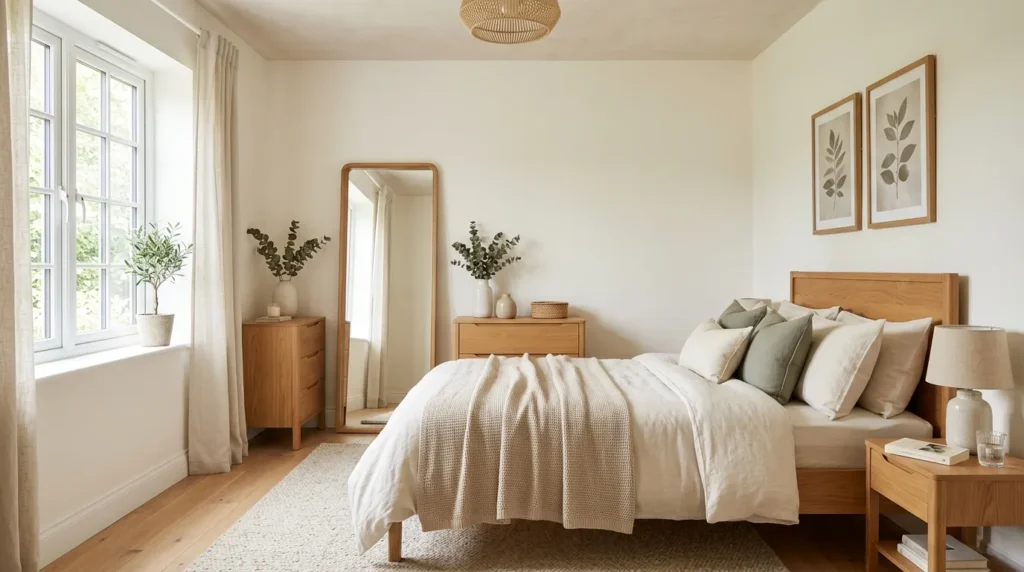
Physical space isn’t the only thing that affects how large a bedroom feels.
Visual weight matters too.
Dark, bulky furniture can make one side of a room feel heavy. Too many small decorative objects can create visual noise. A lack of light can make the room feel enclosed.
Balance these elements and the room can feel more open without gaining a single square foot.
How To Style It
Use lighter colors on large surfaces when they suit your style.
Choose furniture with appropriate proportions.
Repeat a few colors rather than introducing too many unrelated shades.
Use mirrors strategically when they genuinely improve the room’s light or sense of depth.
Keep window areas relatively open so natural light can travel through the room.
Add texture through bedding, rugs, curtains, and cushions rather than relying entirely on decorative objects.
Related Articles
- Small Bedroom Organization Ideas
- Small Bedroom Storage Ideas
- Bedroom Layout Ideas
- Small Bedroom Decorating Ideas
- Minimalist Bedroom Ideas
Frequently Asked Questions
How can I make a small bedroom look bigger?
Start by improving the layout and keeping major walking paths clear. Use appropriately scaled furniture, reduce unnecessary pieces, take advantage of vertical storage, and keep large surfaces visually calm. Light colors and natural light can also contribute to a more open appearance.
Where should I put my bed in a small bedroom?
Whenever the room allows, position the bed where it creates the best combination of balance and circulation. Centering it on a suitable wall can look intentional, while placing it against a wall may save space in a very narrow room. Always prioritize access to doors, closets, and walking paths.
Should furniture be against the walls in a small bedroom?
Not necessarily. Pushing every piece against the wall can sometimes create awkward layouts. However, in a very small room, keeping certain larger pieces against walls may preserve valuable floor space. Test different arrangements and choose the one that creates the best movement.
What furniture should I remove from a small bedroom?
Start with pieces you rarely use or that duplicate another function. Oversized chairs, extra cabinets, bulky nightstands, and unnecessary storage furniture are common candidates. Removing even one substantial piece can create more useful floor space.
How do I arrange furniture in a narrow bedroom?
Place the bed and major furniture so they don’t interrupt the room’s longest walking path. Consider grouping storage along one wall and keeping the opposite side relatively open. Choose shallow furniture where possible and avoid filling the narrowest section with unnecessary pieces.
Does a mirror make a small bedroom look bigger?
A strategically positioned mirror can make a room feel brighter and create a greater sense of visual depth, particularly when it reflects natural light or an attractive part of the room. However, simply adding multiple mirrors won’t automatically make a bedroom feel larger.
How much furniture should a small bedroom have?
Only as much as the room needs to function comfortably. A bed, essential clothing storage, and a small bedside surface may be enough. Additional furniture should earn its floor space by providing a useful function that you actually need.
Conclusion
Making a small bedroom feel open isn’t about squeezing more storage into every available corner.
It’s about making thoughtful decisions about where things go and what deserves your limited floor space.
Start with the bed, because it usually determines the rest of the layout. Then look at the entry path, closet access, furniture depth, and everyday movement around the room.
Use vertical space when you need additional storage, consider overlooked corners, and don’t automatically assume every wall needs furniture.
Most importantly, give yourself permission to remove pieces that aren’t genuinely useful.
An open area of floor can be just as valuable as a dresser. A clear view from the doorway can make the room feel more inviting. A simple nightstand can work better than an oversized one filled with drawers you rarely use.
You don’t need to completely redesign the bedroom to notice a difference.
Move one piece. Clear one path. Remove one unnecessary item. Then live with the new arrangement for a little while.
Often, the smartest small-bedroom layout isn’t the one that fits the most things.
It’s the one that makes everyday life feel easiest.