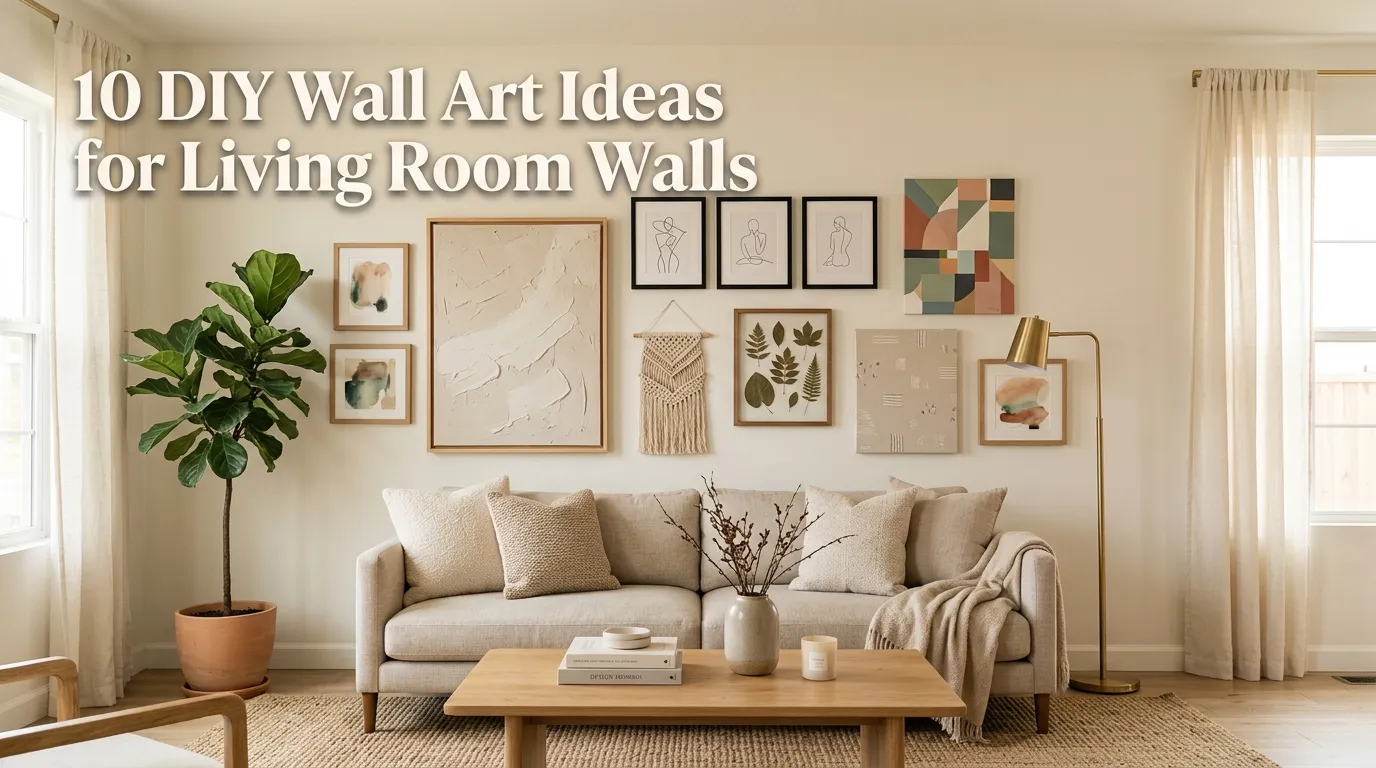
10 DIY Wall Art Ideas for Living Room Walls
Blank living room walls can make an otherwise beautiful home feel unfinished. The good news is that you don’t need an expensive gallery wall or designer artwork to give those empty spaces personality.
DIY wall art is one of the easiest ways to make a living room feel more personal while working with the colors, furniture, and architecture you already have.
The trick is to create pieces that look intentional rather than overly crafty. Simple materials, oversized proportions, natural textures, and restrained color palettes can produce artwork that feels surprisingly polished.
I’ve found that large-scale art is particularly useful in living rooms. A single oversized canvas can fill the wall behind a sofa, while a collection of smaller pieces can work beautifully above a console table or reading nook. Even inexpensive materials such as fabric, paint, paper, wood, or thrifted frames can become attractive focal points with the right composition.
Another advantage of making your own art is flexibility. You can choose colors that coordinate with your rug, pillows, curtains, or accent chair instead of trying to decorate around a finished piece.
These projects range from extremely simple abstract designs to more textured ideas that can become genuine weekend projects. Some require only basic craft supplies, while others work best if you enjoy experimenting with materials.
Whether your living room is modern, farmhouse, boho, traditional, or somewhere in between, the ideas below can be adapted to fit your style.
Before starting, consider the size of your wall, the furniture underneath it, and how much visual weight the room can handle. The goal isn’t simply to fill empty space. It’s to create artwork that makes the entire room feel more complete.
Table of Contents
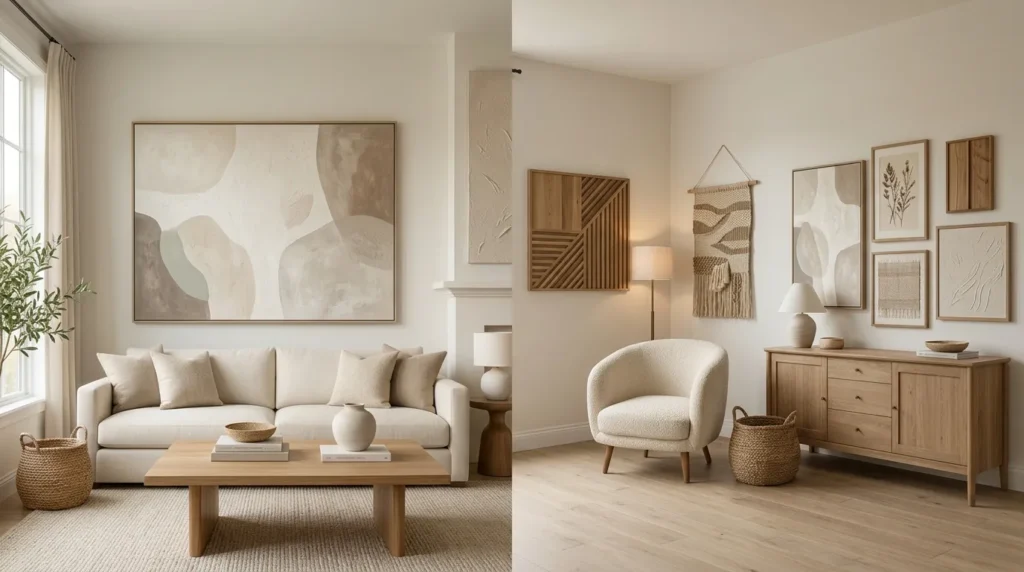
1. Oversized Abstract Canvas
Create a large statement piece with simple shapes and a restrained color palette.
2. Textured Plaster Art
Add dimension with a raised artwork design using textured materials.
3. Framed Fabric Art
Turn beautiful fabric into an affordable decorative wall piece.
4. Painted Arch Panels
Use simple geometric arches to create modern, architectural artwork.
5. Botanical Pressed Art
Display pressed leaves and flowers for a natural handmade look.
6. DIY Landscape Painting
Create a soft landscape scene that adds calm visual interest.
7. Wooden Slat Artwork
Combine natural wood pieces to create dimensional wall decor.
8. Minimal Line Art
Make understated artwork with simple continuous lines.
9. Vintage Frame Gallery
Create a collected gallery using thrifted and mismatched frames.
10. Paper Collage Art
Layer paper shapes and textures into a custom abstract composition.
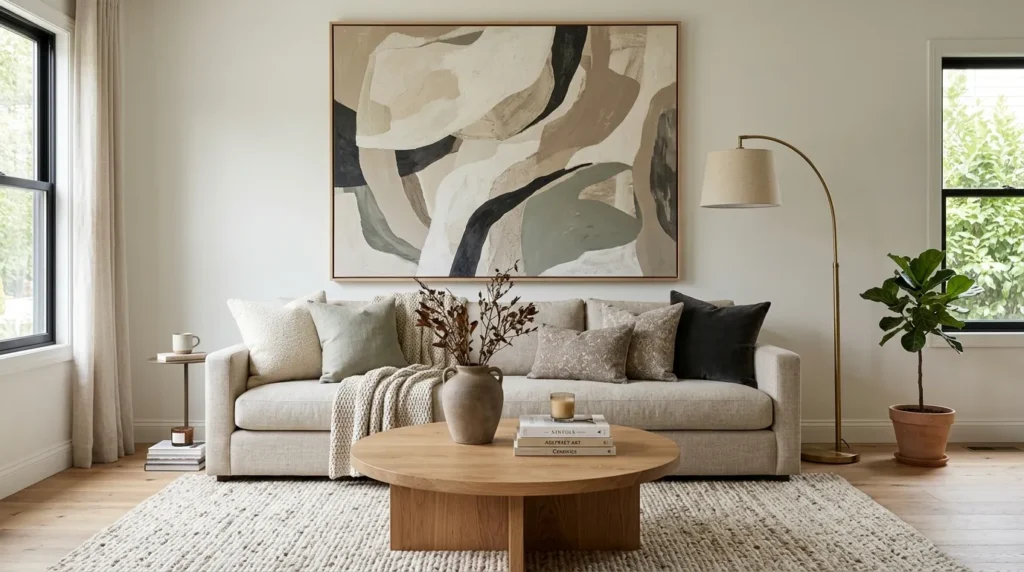
1. Oversized Abstract Canvas
Quick Benefits
- Creates an instant focal point
- Works above large furniture
- Easy to customize
- Requires minimal artistic detail
- Can coordinate with existing decor
Why It Works
An oversized canvas can solve one of the most common living room decorating problems: a large wall with nothing substantial enough to anchor it.
Abstract artwork is particularly forgiving because the goal isn’t to reproduce a specific object accurately.
Instead, you can work with shapes, brushstrokes, color blocks, and texture.
A neutral abstract canvas can also complement many decorating styles without competing with furniture.
For a polished appearance, limit the palette to three or four related colors.
How To Style It
Start with a large blank canvas sized appropriately for your wall.
Choose colors already present in the room.
Try warm white, beige, taupe, charcoal, muted green, or dusty blue.
Paint large organic shapes first, then add smaller brushstrokes or subtle texture.
Hang the finished canvas centered above the sofa or console.
For a large sofa, one substantial artwork can often look more balanced than several tiny pieces.
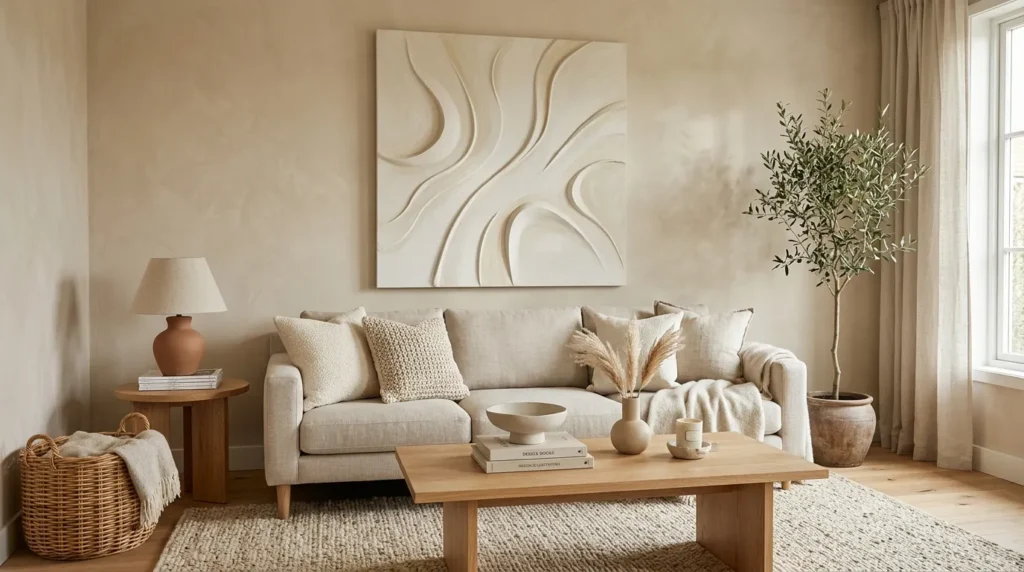
2. Textured Plaster Art
Quick Benefits
- Adds three-dimensional texture
- Works with neutral interiors
- Creates a sophisticated appearance
- Doesn’t require detailed painting
- Excellent for modern living rooms
Why It Works
Texture can make simple artwork feel much more substantial.
Raised plaster-style artwork creates shadows as natural light moves across the surface, giving the piece visual interest without relying on bold colors.
The simplicity makes this approach especially suitable for modern, minimalist, organic, and contemporary living rooms.
You can create subtle waves, arches, lines, or abstract forms.
How To Style It
Use a sturdy art board or canvas suitable for your chosen medium.
Apply an appropriate texture medium with a palette knife.
Create broad curved lines or abstract raised shapes.
Allow the material to dry completely according to its instructions.
Paint the surface in warm white, ivory, beige, or another neutral shade if desired.
Place it above a wood console or neutral sofa to emphasize the texture.
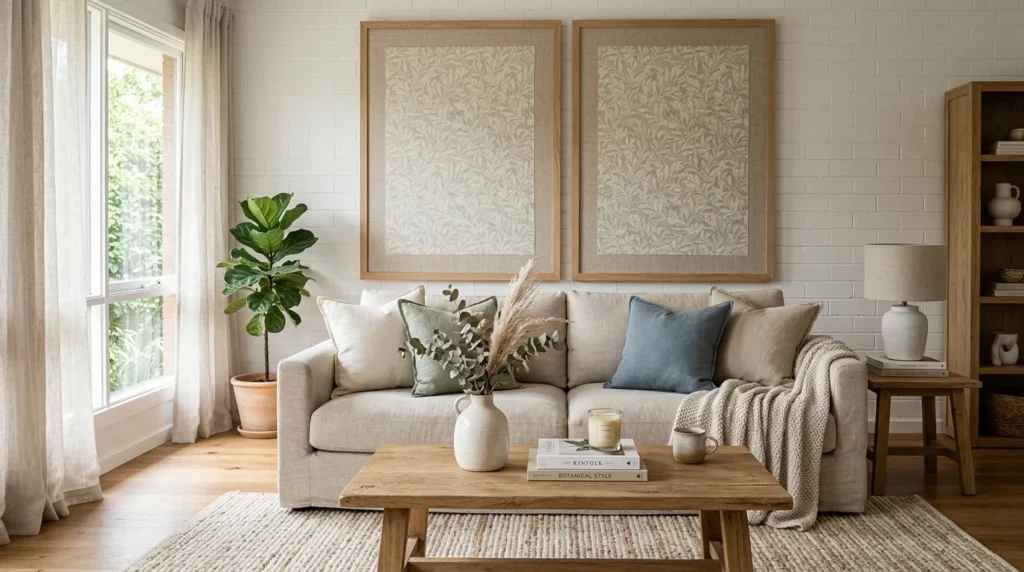
3. Framed Fabric Art
Quick Benefits
- Extremely customizable
- Adds softness
- Uses beautiful textile patterns
- Works with leftover fabric
- Can be completed quickly
Why It Works
Fabric is an underrated source of wall art.
A beautiful textile can bring color, pattern, and texture into a living room without requiring advanced painting skills.
This is especially useful when you find a fabric you love but don’t have enough of it for curtains or upholstery.
Framing it transforms the material into a large decorative statement.
How To Style It
Choose a fabric with a pattern or texture that complements the room.
Stretch it smoothly over a suitable backing board.
Secure it carefully on the reverse side.
Place it inside a large frame.
For a sophisticated look, choose linen, cotton, woven textiles, or fabric with subtle botanical or geometric patterns.
Coordinate one or two colors from the textile with pillows or other room accents.
4. Painted Arch Panels
Quick Benefits
- Creates architectural interest
- Easy geometric design
- Works in modern interiors
- Can be customized by color
- Looks polished when grouped
Why It Works
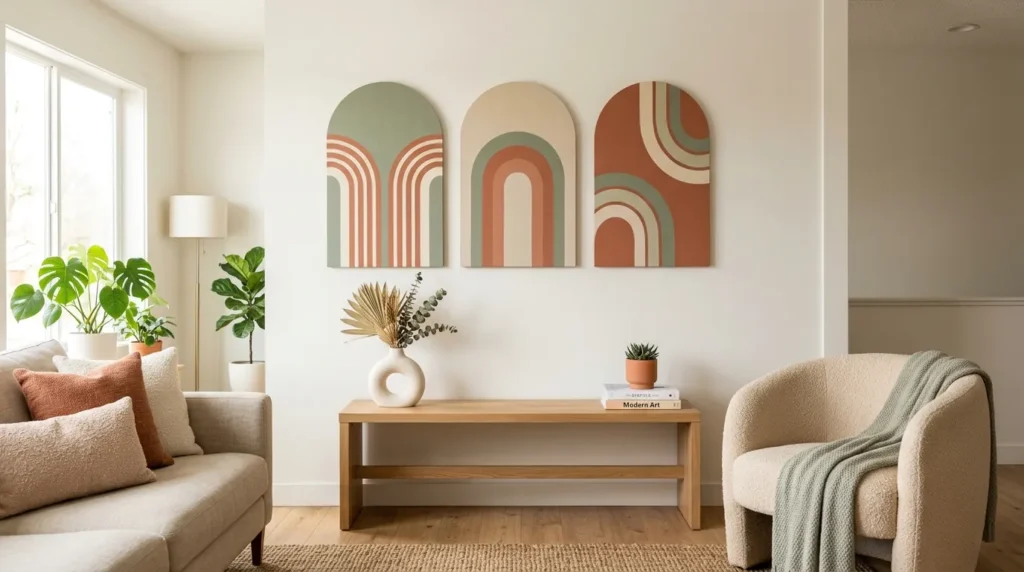
Arches bring a soft architectural quality to artwork.
Instead of painting an entire canvas with complicated imagery, you can create simple overlapping arches using a few complementary colors.
This is an excellent project when you want handmade art that still looks clean and contemporary.
The repeated curves can also echo rounded furniture, mirrors, lamps, or architectural details already present in the room.
How To Style It
Use three coordinating shades.
Start with a warm neutral background.
Mark your arch shapes carefully.
Paint each section with a consistent finish.
Consider creating two or three panels with related designs.
Hang them with even spacing above a console or sofa.
For a softer look, use muted beige, clay, cream, and dusty green.
5. Botanical Pressed Art
Quick Benefits
- Brings nature indoors
- Works with neutral decor
- Adds delicate detail
- Can be inexpensive
- Looks beautiful in groups
Why It Works
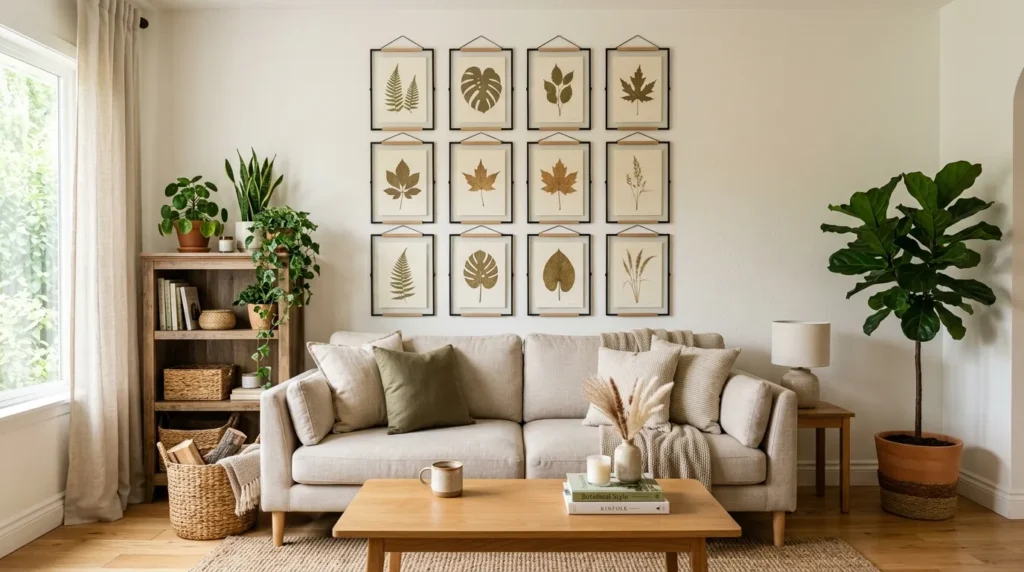
Pressed leaves and flowers create artwork with genuine natural variation.
No two leaves are exactly alike, which gives the finished pieces a collected quality.
Botanical artwork is especially useful when your living room already contains wood furniture, woven baskets, linen textiles, or indoor plants.
The natural subject matter helps connect these elements visually.
How To Style It
Choose leaves or flowers that can be safely dried and pressed.
Arrange them on cream or white archival-style paper.
Use simple black, wood, or antique-style frames.
Create a symmetrical arrangement for a traditional appearance.
Use mismatched frames for a more collected look.
Leave enough space around each botanical specimen so the artwork doesn’t feel crowded.
6. DIY Landscape Painting
Quick Benefits
- Adds calm visual interest
- Works with traditional decor
- Can use muted colors
- Creates a custom focal point
- Doesn’t require photorealistic painting
Why It Works
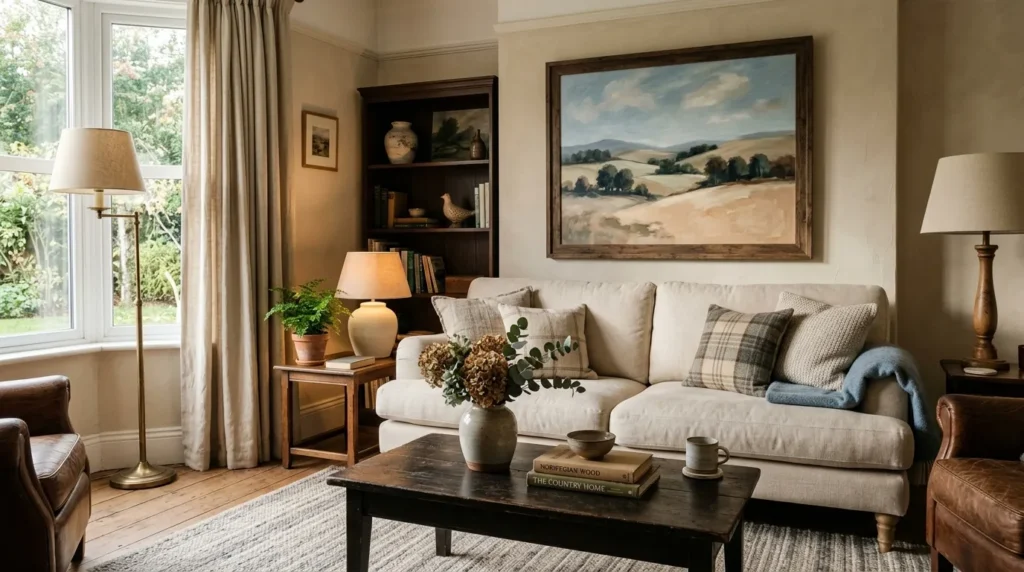
A simple landscape can bring a sense of depth to a living room.
You don’t need advanced painting skills to create something attractive.
A few overlapping hills, trees, clouds, or fields can create an atmospheric image.
Soft edges and muted colors are particularly forgiving because small imperfections can become part of the handmade quality.
How To Style It
Use a horizontal canvas for a sofa wall.
Choose colors that already appear in your room.
Try muted greens, dusty blue, warm beige, cream, and soft gray.
Paint distant shapes first and gradually add closer elements.
Keep details loose rather than attempting precise realism.
Frame the finished painting if the room benefits from a more traditional appearance.
7. Wooden Slat Artwork
Quick Benefits
- Adds natural texture
- Works with modern interiors
- Creates dimension
- Complements wood furniture
- Can become a large focal point
Why It Works
Wood naturally adds warmth to living rooms.
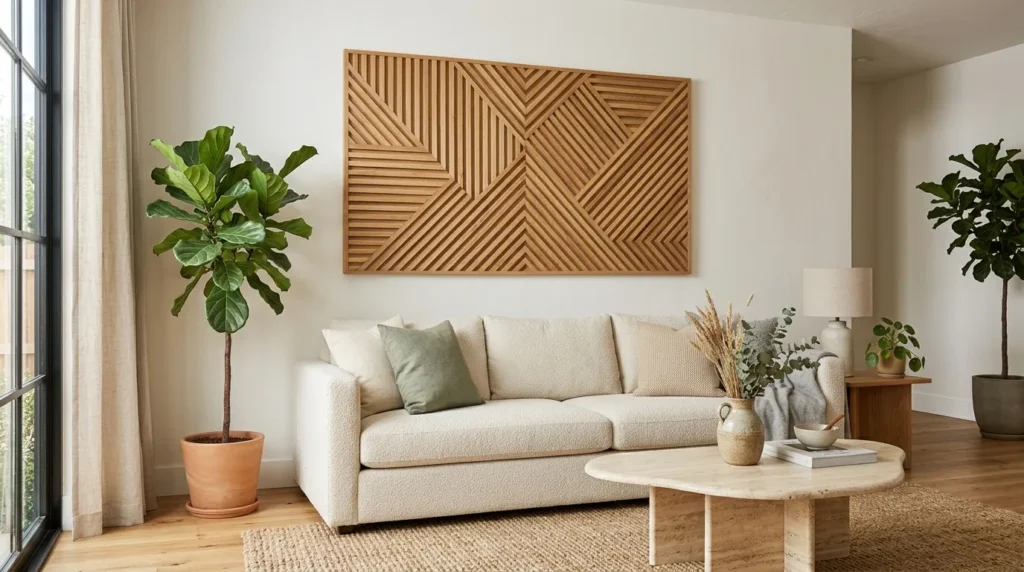
Instead of using wood only for furniture or shelving, turn it into wall art by arranging narrow pieces into a geometric composition.
The changing direction of the slats creates shadows and movement.
This works particularly well when the room contains neutral upholstery and needs a warmer focal point.
How To Style It
Use properly prepared wood pieces suitable for indoor use.
Experiment with horizontal, vertical, or angled arrangements before attaching anything.
Keep the finish natural for an organic appearance.
Alternatively, use a light stain that coordinates with your existing furniture.
Mount the finished arrangement securely according to the wall and material requirements.
Place it above a sofa, console, or media cabinet.
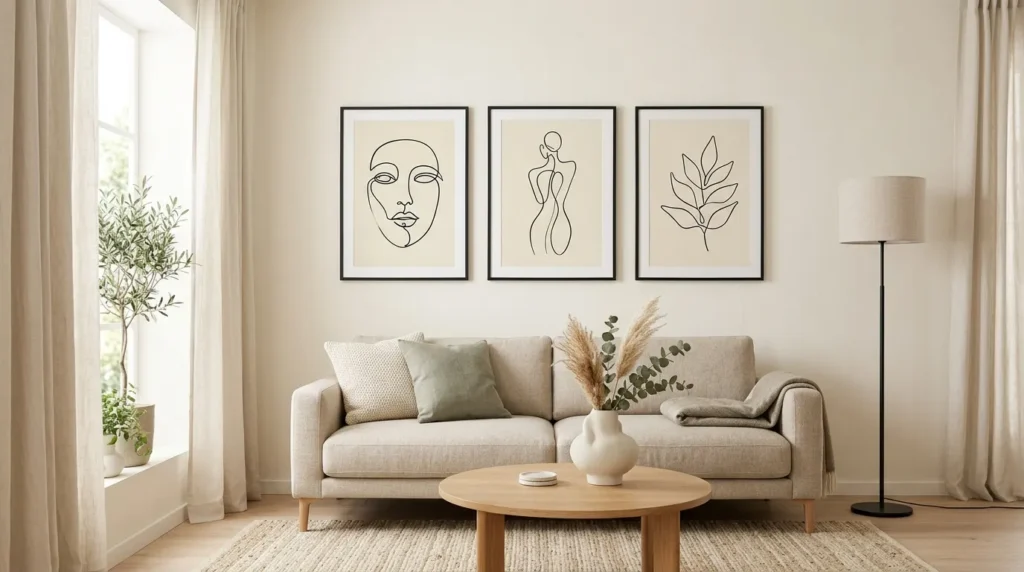
8. Minimal Line Art
Quick Benefits
- Very inexpensive
- Easy to customize
- Works in small spaces
- Creates a modern appearance
- Pairs well with neutral decor
Why It Works
Sometimes a living room doesn’t need another complicated focal point.
Minimal line art can add personality while keeping the overall room calm.
Simple faces, abstract figures, botanical outlines, or continuous curves can create attractive compositions using very few elements.
This makes line art particularly useful in minimalist, Scandinavian, contemporary, and organic interiors.
How To Style It
Use cream or white paper as the background.
Draw with black, charcoal, brown, or another muted tone.
Create one large design or several coordinated pieces.
Use thin frames for a modern appearance.
For a larger wall, group several line drawings together.
Maintain consistent spacing between frames.
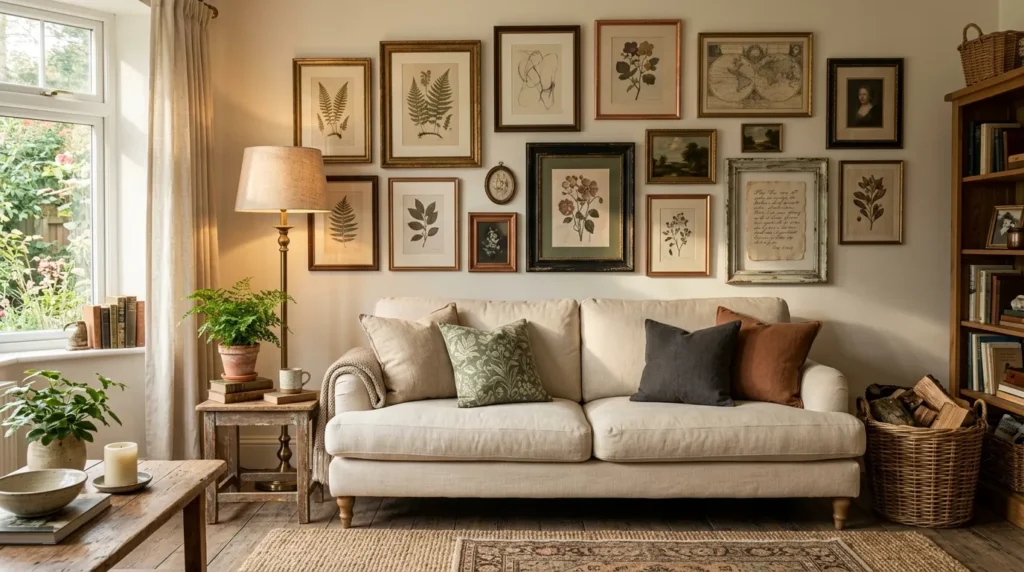
9. Vintage Frame Gallery
Quick Benefits
- Creates collected character
- Uses thrifted materials
- Highly customizable
- Works with many decor styles
- Can grow over time
Why It Works
A gallery wall doesn’t have to come from a matching store-bought set.
Thrift stores, flea markets, estate sales, and secondhand shops can provide interesting frames with unique details.
You can fill them with your own artwork, vintage-inspired prints, botanical pages, fabric, photographs, or abstract designs.
The variation makes the wall feel collected over time.
How To Style It
Gather frames in several related finishes.
Lay them on the floor before hanging them.
Create a balanced arrangement rather than trying to make every gap identical.
Use one repeated element to unify the collection.
For example, keep the artwork mostly neutral while allowing the frames to vary.
Start with the largest piece and build outward.
Use appropriate hanging hardware for each frame and wall surface.
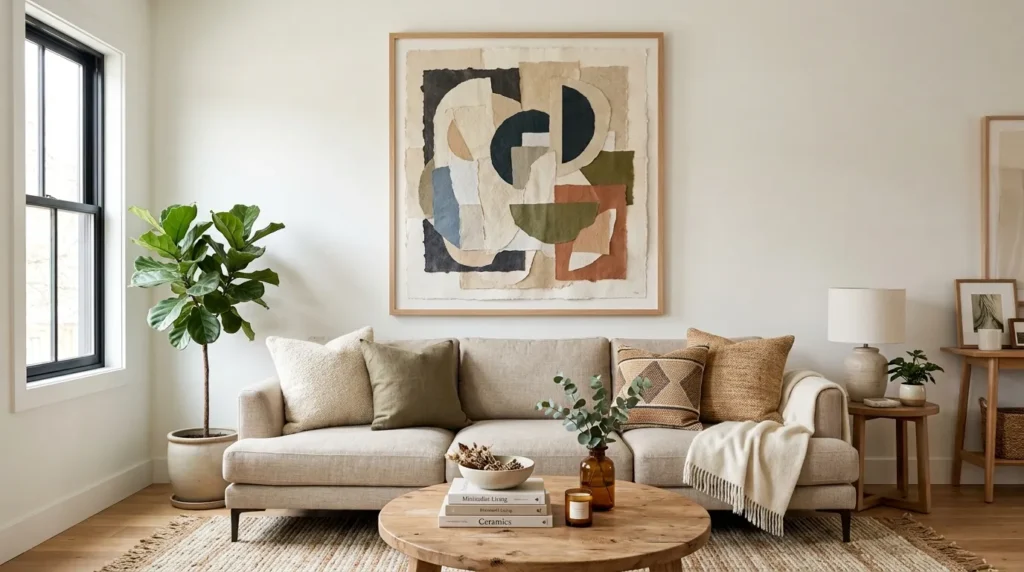
10. Paper Collage Art
Quick Benefits
- Requires inexpensive materials
- Highly customizable
- Easy to experiment with
- Works with abstract interiors
- Creates layered visual interest
Why It Works
Paper collage allows you to build artwork gradually.
You can combine different shades, shapes, textures, and patterns until the composition feels right.
This makes it a good choice if you enjoy experimenting but don’t consider yourself a painter.
Neutral paper collage can look surprisingly sophisticated when the shapes and palette remain controlled.
How To Style It
Choose heavyweight papers in complementary colors.
Try cream, beige, charcoal, tan, muted blue, olive, or terracotta.
Cut organic and geometric shapes.
Arrange them before gluing.
Experiment with overlapping layers.
Mount the final composition behind glass or in a deep frame if the materials have significant texture.
How To Choose DIY Wall Art for Your Living Room
The best artwork starts with the wall rather than the craft project.
Look at the size of the furniture underneath it.
A tiny artwork above a large sectional can disappear.
Likewise, an enormous piece above a small console can overwhelm the furniture.
As a general design principle, artwork should relate visually to the furniture below it.
Color matters too.
You don’t need the artwork to match the sofa exactly.
Instead, pull one or two colors from existing elements such as:
- Area rugs
- Throw pillows
- Curtains
- Accent chairs
- Wood tones
- Decorative objects
This creates a connection without making the room look overly coordinated.
How Big Should DIY Wall Art Be?
For artwork above a sofa, the composition generally looks better when it has enough visual width to relate to the furniture.
One oversized piece can make a strong statement.
A group of smaller pieces can create a similar overall footprint.
If you’re unsure, cut paper rectangles to the approximate size of the proposed artwork and temporarily place them on the wall.
This simple trick lets you judge scale before spending money on materials.
How To Make DIY Art Look Expensive
The secret is usually restraint.
Choose a limited color palette.
Use quality-looking materials.
Keep the composition simple.
Choose a frame that complements the artwork.
Don’t overcrowd the piece with details.
Large artwork often looks more substantial when the design has generous negative space.
Texture can also help.
Natural linen, textured paper, wood grain, raised plaster, and handmade ceramics can make a simple piece feel more dimensional.
Most importantly, take your time with the finishing details.
Straight edges, clean frames, smooth mounting, and careful placement can make a significant difference.
Best DIY Wall Art Materials
You can create beautiful artwork from surprisingly simple materials.
Consider:
- Canvas
- Heavyweight paper
- Linen
- Cotton fabric
- Wood
- Air-dry or appropriate texture medium
- Paint
- Natural leaves
- Thrifted frames
- Cardstock
- Handmade paper
- Wallpaper remnants
Before choosing a material, consider where the artwork will hang.
For example, artwork above a fireplace or in a high-traffic area may need additional consideration regarding heat, dust, and safety.
DIY Wall Art Mistakes to Avoid
Choosing artwork that is too small: Large walls usually need sufficient visual weight.
Using too many colors: A restrained palette is often easier to integrate.
Ignoring the frame: The frame is part of the final design.
Hanging everything too high: Artwork should relate to the furniture and viewing height.
Creating unnecessary clutter: Not every empty wall needs multiple pieces.
Skipping a test layout: Paper templates can prevent costly mistakes.
Ignoring the room’s existing style: Handmade doesn’t mean unrelated.
Using unsuitable materials: Choose products appropriate for the intended indoor location.
FAQ
What is the easiest DIY wall art for a living room?
An oversized abstract canvas is one of the easiest options because it doesn’t require precise drawing skills. You can work with simple shapes, broad brushstrokes, and a limited color palette. Fabric art and minimal line drawings are also beginner-friendly alternatives when you want a finished piece without complicated techniques.
How can I make cheap wall art look expensive?
Use a restrained color palette, larger proportions, quality-looking materials, and a simple frame. Avoid overcrowding the design. Textured materials such as linen, wood, handmade paper, and raised artwork can also create a more substantial appearance. Careful framing and proper wall placement often make as much difference as the artwork itself.
What should I put on a large blank living room wall?
An oversized canvas, large textile artwork, a collection of framed pieces, wooden wall art, or a substantial gallery arrangement can work well. Consider the size of the furniture below the wall and choose artwork with enough visual weight to balance it.
How do I choose DIY art colors for my living room?
Start with colors already present in the room. Pull one or two shades from your rug, pillows, curtains, furniture, or accessories. You can then add a neutral such as cream, beige, gray, or charcoal to balance the palette. Matching every color exactly isn’t necessary.
Is DIY wall art good for a modern living room?
Yes. Simple abstract paintings, textured plaster pieces, geometric panels, wooden slat designs, and minimal line art can all work beautifully in modern interiors. The key is keeping the composition clean and choosing materials and colors that complement the room’s existing furniture.
How do I arrange multiple DIY artworks?
Start by deciding the overall shape of the arrangement. Lay the artwork on the floor first and experiment with spacing. Begin with the largest piece and add smaller pieces around it. Keep the visual weight balanced rather than making every frame identical. A paper template can help you test the arrangement on the wall.
Should living room art match the furniture?
It doesn’t need to match exactly. It should relate to the room through color, scale, texture, or style. For example, neutral artwork can complement a colorful sofa, while a wood wall piece can echo the wood tones of a coffee table or shelving unit.
Conclusion
DIY wall art is one of those projects where a few thoughtful choices can make a surprisingly big difference.
You don’t need advanced artistic skills or a large budget to create something beautiful.
Start by looking at your living room as a whole.
Consider the size of the wall, the furniture underneath it, the colors already present, and the amount of visual texture the space can handle.
Then choose a project that fills a genuine decorating need.
An oversized abstract canvas can anchor a large sofa. Textured artwork can add depth to a minimalist room. Fabric art can introduce pattern, while botanical pieces can bring nature indoors.
If you’re working with a tighter budget, try thrifted frames, paper collage, simple line art, or wooden elements.
And remember that the finishing details matter.
A carefully chosen frame, clean mounting, thoughtful spacing, and appropriate scale can make handmade artwork feel intentional and sophisticated.
You don’t have to complete the entire living room in one weekend.
Start with one blank wall and one project you genuinely enjoy making. Once it’s finished, you may find that the artwork gives you a clearer direction for the rest of the room.
The best DIY wall art isn’t necessarily the most complicated piece.
It’s the one that makes your living room feel more personal, finished, and like home.
Related Articles
- 10 Modern Living Room Ideas With Luxury Style
- 10 Cozy Living Room Decor Ideas for a Warm Home
- 10 Living Room Accent Wall Ideas
- 10 Gallery Wall Ideas for Every Decorating Style
- 10 Budget-Friendly Living Room Decorating Ideas